Tuesday, May 9, 2017

Jaws #PIReviews

Jaws: Review/Analysis
By: Cameron Smith

Image result for jaws

Directed by: Stephen Spielberg
Starring: Roy Scheider, Richard Dreyfuss, Robert Shaw, Murray Hamilton.

   Ah, yes... the definition of classic! Arguably Spielberg's best, and undoubtedly the film that put him on the map. What it did (and still does) expertly is mix the most exciting elements of film: including horror, suspense, comic relief, conflict, salty dogs, song, and greedy, unlikable politicians. I'm not saying anything new here, since I've heard not one casual viewer or critic argue in opposition of this film. As an audience member, I believe this film to be extremely exciting and enjoyable, never having a dull or unneeded moment; it makes me scared, giddy, full of laughs, and on the edge of my seat every time. From an aesthetic point of view, I don't know how anybody can jump to the conclusion of "outdated and fake," as Bruce the Mechanical Shark plays his role expertly and the blood looks realistic to the point where there should be a disclaimer of "NO PEOPLE WERE HARMED..." On a serious note, I love how this film makes me want to sweat at the sight/contrast of the Amity Island sunshine, tense up at John Williams' score, and be (almost) nostalgic for a past family trip to Cape Cod. This film is almost like the antithesis of Chicago: instead of hitting all the wrong chords, this film hits all of the right ones for me.

   The happiest moment of the film, for me, was definitely the ending. I feel this way because (even though I am left to wonder how/when they get back to shore) there is a real sense of accomplishment, especially in Martin Brody (Roy Scheider) -- an everyday policeman who (ironically) took a vacation to escape crime and saves the Amity Islanders. Along with that, I love how Brody ends up killing the shark with a combustible oxygen can. One reason I love this so much is because Marine biologist Matt Hooper (Richard Dreyfuss, NOT the father of Julia Louis-Dreyfus from Seinfeld) scolds Brody of the dangers in those cans falling, and in that moment, he uses Hooper's warning as a genius way of ridding Amity Island of the Great White. The second reason I am head-over-heels for this scene is because the exterminator of the Great White ends up not being the salty dog captain Quint (Robert Shaw), but rather a simple, out-of-town family man who is in it not for the money, but rather for the safety of Amity Island beach goers. Furthermore, he no longer has to be afraid of the water -- even though I would probably feel the opposite!


   Other than that, I don't know what other new things I can say about this film -- it's great, in every single way: exquisite acting/timing, masterful tracking/P.O.V. shots, timeless special effects, and a perfect depiction of who and what it truly takes to save the day. It's a film that brings joy (along with Aquaphobia) to boys and girls everywhere, and still holds up after almost 42 long years.

Monday, May 8, 2017

The Breakfast Club #PIReviews

The Breakfast Club
By: Cameron Smith
Image result for breakfast club stereotypes
Directed By: John Hughes
Starring: Anthony Michael Hall, Ally Sheedy, Emilio Estevez, Molly Ringwald, Judd Nelson, Paul Gleason.

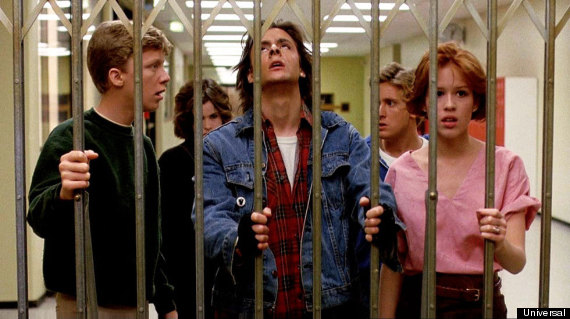
    What a perfect film to succeed Rebel Without a Cause... It is a great example of how the teen genre evolved, and the ultimate crowd-pleaser. It is not only a classic to the generation of this film, but is likewise timeless, giving great enjoyment to the kids after them and of today. In this review, that is one of the things I will harp on later. First, I will run down the list of things I love about this film: great period soundtrack, timeless referential humor, strong tendency to connect with teenagers through the protagonists, ability to mix emotionally tense scenes with humorous counterparts, and altogether, just plain fun! Now, on to the more nitty-gritty of this timeless film (yes, I tend to use that term a lot).

    The most apparent piece of symbolism in this film are the five stereotypes, of which these five characters each conform to. The stereotypes are already apparent to us, the audience, and to those who are fans of the film, so I won't go in depth on what the stereotypes are and what they mean. One interesting thing this film does is use each student as a representative for each "clique" -- group of high school kids who conform to a social norm, hobby, or philosophy. During this Saturday detention, they separate themselves from each other, but eventually come to communicate, learn each other's background, and realize that they are one group and one group only: teenagers. The categories which they live and are judged by have been placed on them by their society and parents to make sure they don't walk among certain crowds, a product of our own evolution. Each strove for perfection in the eyes of both their peers and their parents, and hence, "were brainwashed."

    In the end, (coming from a teenager) this film portrays adolescents very well. Instead of dwelling on the common trope of us being simple, spoiled, lazy brats, this film explains that all teens go through the same issues in one way another and don't get around them because of what clique they're in. Luckily, we have made progress since 1985, but we still have a ways to go in tearing down teenage barriers and coming together to solve the problems we face. For the progress we have made, however, this film certainly played a part in that. This film will soon go down as more than just a crowd-pleaser; it will be remembered -- much like Rebel Without a Cause -- as a historical artifact.

Friday, May 5, 2017

Caitlin Willis- The Breakfast Club

Caitlin Willis
Intro. to Film Studies
5.5.17

The Breakfast Club

Image result for breakfast club movie

          This movie, by far, is one of my most favorite movies ever. I first watched it when I was first entering high school and many, many times after that. I feel as though this movie portrays high school in a way that not many movies do. Of course most films have similar characters: princess, athlete, basket case, brain, and criminal, but not many allow the characters to step outside of their respective personalities. However, The Breakfast Club did.
          Five students, one Saturday detention, nine hours. This was how long it took for us to delve deep into the minds of the stereotypical characters. We learned about why each of them were in detention, some of which revealed a deeper truth about the person they really were. Take Andrew, the jock, for example. He received his Saturday detention because he bullied and outright humiliated a less popular student. He did it to impress his jock friends and his father but it proved true that he wasn't like most jocks. He deeply regretted it and wished he could go back and change it.
          Each person helped to disprove the others stereotypes. Everyone assumed that John was a criminal just because he wanted to be but didn't realize he came from an abusive household. They all assumed that Claire wasn't a virgin and that Brian actually enjoyed being studious. They all believed that Allison was genuinely crazy and were surprised to find out that she just needed friends.
          This movie helped to shine light on high school cliques and the difficulties that come with being in one. Even if you're an accepting and genuine person, making friends with people outside of your clique can be troublesome. Despite the day of bonding, Claire, John, and Andrew all agreed that they're never going to talk to each other again. Only Brian and Allison said they would and that's because the two of them didn't have friends.
            I feel as though this movie is a must watch for anyone in high school. This movie just helps to show that people aren't who you think they are or who they claim to be. It has a good message beneath it that everyone, not only high school students, should learn. 

Wednesday, May 3, 2017

Rebel Without a Cause #PIReviews

Rebel Without a Cause
By: Cameron Smith

Directed by: Nicholas Ray
Starring: James Dean, Sal Mineo, Corey Allen.

As an aspiring musicologist, there was a point in time where I was immersed in the music and rebellion culture of the mid-century (particularly, the 1950s and 60s). I remember then hearing about this film a few times, but never got around to watching it -- that is, until now. It is quite easy for the modern audience to judge this film as dated, and I certainly did during parts; I do, however, see and appreciate more and more the film's historical significance. This film, along with J.D. Salinger's masterpiece Catcher in the Rye, gave a voice to the voiceless American youth, which is in a lot of ways today taken for granted. Youth culture has come a long way since 1955 -- with music, film, literature, etc. -- and us youth today tend to take for granted what our ancestors paved for us, only so we could have whatever hairstyles we wanted and not abide by society's standards. Suffice to say, I am happy that James Dean, J.D Salinger, Chuck Berry, Elvis Presley, the Beatles, Robert Johnson, Jimi Hendrix, and the other pioneers of youth rebellion disobeyed those standards so we didn't have to obey them today.

In this review, I am not going to discuss the "dated" nature of this film; it is obvious and inevitable that certain aesthetics and choices of wording in the film are not going to hold up to today's (ironically) standards. I will say that, overall, this was a very enjoyable film to watch, and it was great to look through a historical lens and see an invaluable part of the adolescent culture's development. This film would clearly not be what it is without James Dean, who was a tragic loss; I would have loved to see where his career went after reaching his status and where he would have been today had he lived long enough. I would really like to sit down and watch this film again, this time through the lens of a period audience (at least as close as I can get!), and therefore get more out of it.

Tuesday, April 25, 2017

Rebel Without a Cause

Gabby Jeannette
4/25/17

Image result for rebel with a cause james dean


          Rebel Without a Cause was a wonderful movie to bring out the theme that you can only depend on yourself [nice opening statement]. James Dean played Jim Stark, an emotionally confused teen which causes him to land in situations that make it [things?] worse for him. In the movie on many occasions Jim had to choose the right choose since nobody else was there for in [him]. (I think what you are trying to say is that 'on many occasions Jim must make tough choices independently because his cries for help, mostly to his father, fall on deaf ears.)  At one point when he has to choose between staying home or going out at night and racing the "cool kids." With the poor advice from his dad, he made the consensus choice [conscious choice] to stand up for himself. Towards the end of the movie his rebel ways were no longer to make his life better but to make the lives of people around him better [good]. He broke into the castle place to be able to talk to the girl [Judy played by Natalie Wood, who also played Maria in West Side Story] he liked and take the stress from the death away and also he put his life on the line by walking out in front of the police for his friend [Plato nee John played by Sal Mineo] that [who] was getting surrounded for his crimes [wounding one of the gang members and firing upon police].

          Besides for the storyline itself Rebel Without a Cause was a pretty decent teen drama [it is by most accounts also the original teen drama] that was put together well. The fact that it is older [1955] and the standards were different brings down my rating of it [ageism?]. Besides for that factor the movie as a whole was fairly good, and I liked how it wasn't predictable. Throughout the whole movie, I had no idea what was going to happen next; SPOILER ALERT!!! I didn't expect either of those characters [Buzz or Plato] to die. Finally at the end I believe that his character progressed greatly; more responsible and caring.  Also, I liked how the suspense factor was very intense and drags you in. When the bully was driving during the race, when his jacket got caught the super zoom on the handle got viewers attentions. The music as well, stuck out and let the viewers knew the tone of the scene greatly. The movie, despite its age wasn't terrible.          

Wednesday, April 12, 2017

Creed


Creed (2015) - Plot Summary Poster


Adonis Johnson  the son of the famous boxing champion Apollo Creed, who died in a boxing match in Rocky IV Adonis wasn't born until after his father's death and wants to follow his fathers footsteps in boxing. He seeks a person who is the former heavyweight boxing champion and former friend of Apollo Creed, the retired Rocky Balboa. Rocky eventually agrees to mentor Adonis. With Rocky's help they hope to get a title job to face even deadlier opponents than his father. But whether he is a true fighter remains to be seen.

Rocky decides to take Donnie under his wing. Donnie stays at Rocky's house as they train bright and early, while gaining a  close bond.
Later in the movie before Donnie big fight with Conlan ,he starts having doubts about not being about to take after his father foot steps /not fulfill his father legacy. The fans were not thrilled t see Donnie and started booing and jeer at him. The end of the movie sadly Donnie didn't win the fight against Conlan but Conlan recognized his hard work with respect

Friday, April 7, 2017

Creed: The Stand-Alone Son #PIReviews

Creed: The Stand-Alone Son
By: Cameron Smith
Directed by: Ryan Coogler
Starring: Michael B. Jordan, Sylvester Stallone, Tessa Thompson, Phylica Rashad, Tony Bellew

As a successor to the Rocky series, this film was genius! It not only took the best traits of the 1976 Rocky to another level, but also adds creative variations and elements of our real world to the universe -- providing a strong sense of realism. This could have easily been a cliche and cheesy nod to the former films, but it turned out to be anything but; instead, it gave new, modern life to what seemed as a dying series with it's past two films. It has excellent character development of Adonis Creed (Michael B. Jordan) and chemistry between the aforementioned, his girlfriend Bianca (Tessa Thompson), and the champ Rocky Balboa (Sylvester Stallone). It is clear that Stallone is excellent in the film, but it is also apparent that Michael B. Jordan killed it! I have come across fans of the original who only praise Stallone and didn't (so to speak) dig this one. Again, rather than taking away from the original feel of the series, it added to the appeal and told the same story from a different perspective -- of an African-American. In short, I believe that a good bulk of the complaints against this film are from those who relate more to an Italian-American and don't see the other perspective.

I would like to reiterate that this film was a great revival to the Rocky series/extension of the universe -- and a successful one at that. Not only did the franchise gain a new generation of fans, but also fans who now see the same story from another perspective. The allusions made to the former installments made sense, struck the right chord, and all-in-all done in a way that wasn't forced or overly played out. The training scenes (sometimes) played off the original -- as in with the punching bags -- but also included up-to-date music (my favorite being Nas' "Bridging the Gap"), lines, and settings which gave the film yet another stroke of genius. Thematically, it follows the notion of being a stand-alone, and not only a continuation of your predecessor very well; Adonis "Johnson," despite having an "overnight success" has been through his own struggle as a juvenile delinquent and being disconnected from his father. In short, I cannot wait to see where the series goes from here!