Friday, April 24, 2015
Dean Artusa Class Work Reflection
This trimester i haven't posted any blogs as of now, but i plan to do them this weekend to get back on track, i believe that when i do my blogs they are to a high standard though, so the blogs i will be making up should be expected to be thorough and detailed like my last trimester blogs. so right now i should have a zero out of ten, but i will make the change so i can have at least an eight out of ten because i like to achieve high standards.

Thursday, April 23, 2015
Beasts of the Southern Wild II
I found this movie to be very confusing. What started off as a seemingly straightforward plot turned into a rather odd mixture of events and character development; perhaps my analytical skills are just not up to par yet.
I didn't understand why the older white couple (I don't know their names) stuffed dynamite into the alligator and blew up what appeared to be a small village [it was the levy; a man-made barrier that separates the Bathtub from "civilized society." Wink devised the plan to destroy the levy because it was retaining the saltwater in Bathtub after the storm and killing off the fish and the livestock]. One thing that was very apparent was Hushpuppy's level of maturity and inner strength for someone her age. In the end of the movie, she watched her father collapse and was fully aware of his impending death. While most PEOPLE, let alone most six year-olds, would freak out at the sight of a loved one dying in front of them, Hushpuppy remained entirely composed. She listened to her father's last heartbeat and said goodbye. To me, this movie illustrates that a person's character truly develops only through tough times. There are many grown men and women that haven't been through what Hushpuppy has in her six years of life. I think parents, teachers, and society as a whole tend to underestimate the intelligence and resiliency of children. It's interesting how quick people are to forget that they, too, were children at one point in their lives and were misjudged by their elders, yet they willingly and effortlessly repeat the cycle.
I didn't understand why the older white couple (I don't know their names) stuffed dynamite into the alligator and blew up what appeared to be a small village [it was the levy; a man-made barrier that separates the Bathtub from "civilized society." Wink devised the plan to destroy the levy because it was retaining the saltwater in Bathtub after the storm and killing off the fish and the livestock]. One thing that was very apparent was Hushpuppy's level of maturity and inner strength for someone her age. In the end of the movie, she watched her father collapse and was fully aware of his impending death. While most PEOPLE, let alone most six year-olds, would freak out at the sight of a loved one dying in front of them, Hushpuppy remained entirely composed. She listened to her father's last heartbeat and said goodbye. To me, this movie illustrates that a person's character truly develops only through tough times. There are many grown men and women that haven't been through what Hushpuppy has in her six years of life. I think parents, teachers, and society as a whole tend to underestimate the intelligence and resiliency of children. It's interesting how quick people are to forget that they, too, were children at one point in their lives and were misjudged by their elders, yet they willingly and effortlessly repeat the cycle.
Tuesday, April 21, 2015
Brooklyn Crooklyn...Smooklyn - Shawn Luzzi
Spike Lee piques my interest once more [past experiences include Do the Right Thing and Malcolm X] with this comedic film, Crooklyn, which go through the lives of an eccentric and large black family in Brooklyn. I found quite the interest to the film due to the family presented to us, with the multiple rowdy kids, the strict mother, the father perusing [pursuing?] what seemed like a dead career, and to the main little girl [protagonist], whom grew the most in character compared to the rest of the family.
The movie focuses on Troy, the small little girl in the family, as she shows the most growth in this film compared to all the other characters [redundancy? Didn't you just say this?]. She goes from small sister that's bugged by her brothers, to a small delinquent [here are you referring to her experiences with shoplifting?], to a grown female after coming back from her forced visit to her Aunt's home [elaborate].
During the ending scene, after the disaster that strikes the family, Troy becomes equivalent to her mother, as she now has the duties of a mother and looks after her brothers with the same intent and strictness that her mother had before.
Beasts of the Southern Wild
Benh Zeitlin's 2012 fantasy drama Beasts of the Southern Wild is so far a painfully accurate [accurate or would "realized" be more precise] depiction of life "off the grid" in Southern Louisiana. The film takes place in a bayou called the "Bathtub" and is separated from the civilized world by a levee. The main character, Hushpuppy, is a six year-old girl named "Hushpuppy" [redundancy] who lives in what appears to be third-world poverty with her father, who we know struggles with substance [here are you referring to his alcohol consumption?] abuse problems and possible mental illness.
Despite being a severely poverty-stricken community, the Bathtub's residents display a very easy-going and fun-loving attitude, as well as a love and respect for their community and its people. Early in the movie, we see the Bathtub throwing a massive party with everyone shooting off fireworks and having a great time. Later in the film, however, we catch a glimpse at Hushpuppy's flawed relationship with her father, who exhibits a very unstable and problematic temperament. He is seen walking toward his house in a hospital gown after being MIA for several days. He looked disheveled and appeared to be talking to himself. My first suspicion was that he was schizophrenic.
The last scene we saw in the movie was everyone in the Bathtub talking about an incoming storm. Some people were leaving town, but, as I would imagine, other residents weren't going anywhere. What Hushpuppy and her father end up doing remains to be seen. Overall, I like this film and look forward to finishing it.
Michael,
Your posts are a welcome addition to the class blog. Keep up the good work.
Monahan
Despite being a severely poverty-stricken community, the Bathtub's residents display a very easy-going and fun-loving attitude, as well as a love and respect for their community and its people. Early in the movie, we see the Bathtub throwing a massive party with everyone shooting off fireworks and having a great time. Later in the film, however, we catch a glimpse at Hushpuppy's flawed relationship with her father, who exhibits a very unstable and problematic temperament. He is seen walking toward his house in a hospital gown after being MIA for several days. He looked disheveled and appeared to be talking to himself. My first suspicion was that he was schizophrenic.
The last scene we saw in the movie was everyone in the Bathtub talking about an incoming storm. Some people were leaving town, but, as I would imagine, other residents weren't going anywhere. What Hushpuppy and her father end up doing remains to be seen. Overall, I like this film and look forward to finishing it.
Michael,
Your posts are a welcome addition to the class blog. Keep up the good work.
Monahan
Monday, April 20, 2015
A World Away

Beasts of the Southern Wild takes the viewer into The Bathtub, a wretchedly poor bayou neighborhood, where everything is all but well. Right away I could draw some comparisons to Winter's Bone when it comes to the financial, social, and environmental setting that it takes place in. Both communities resonate an eerie feeling, mixed in with severe poverty, alcoholism, and dysfunctional families. In this particular film, there is a focus on Hushpuppy, a young black girl.
Hushpuppy has a keen sense of nature's actions, and this is communicated very well in this movie. She understands that nature is a fragile cycle - all it takes is one interruption for things to change for the worst. You see, her neighborhood is in a dire situation: the polar ice caps are melting, making the waters rise. Sooner than later, the ocean will swallow the low-lying Bathtub, which means that everyone needs to vacate the island as soon as possible. What strikes me most is that this scenario is perfectly realistic. I have seen a plethora of online articles about communities like this, in which the water is literally getting closer to people's doorsteps day by day as a result of global warming. All it takes is a minor increase in temperature. Unfortunately for Hushpuppy at this point, her father refuses to seek higher ground, believing that he can overcome nature. In fact, in one scene he fires a gun at the sky during a hurricane. On the day after the storm, one of his buddies humorously stepped out of his dilapidated home and fell into the water, which wasn't there yesterday. Instead of being concerned, Hushpuppy's father just helped him get out, and they both laughed it off. Well, it was nice knowing you Hushpuppy. Good luck.
For me, one of the most noticeable, and sometimes annoying aspects of this film is its cinematography. You don't even have to be a filmmaker to know that most of the shots, if not all, are handheld. Some are understandably shaky, while others are unnecessarily so. Do they know what a tripod is? However, looking at it from a different perspective, I am sure that this is intentional - possibly meant to convey how poor the community truly is. In other words, the shaky camera makes the scenes look less staged; this instability represents the peoples' unstable lifestyle, especially now that Mother Nature has begun unleashing its wrath on them. I do like the shot transitions between Hushpuppy and the North Pole, where the ice caps are shown melting, also releasing these huge, Wooly Mammoth-like beasts. I'm not yet sure how they play into the film, but judging from the negative plot, they signal trouble. Can you imagine what living things that have been trapped for thousands of years are capable of doing? Hopefully I'll soon find out.
Tuesday, April 7, 2015
Crooklyn. By Alethia Moore

Crooklyn is a 1994 semi-auto biographical film directed by Spike lee. The protagonist/ storyteller was Zelda Harris who pays the only daughter Troy. The film has a very urban setting in crooklyn, Brooklyn. The fact that the film showed multiple races proves that his urban setting is also very diverse when it come to culture. One thing that I noticed about the film is each culture had it personal relations with people of the same culture, in my eyes it was very rear to see positive interaction amoung the races.
Lee managed to express the average lifestyle of a low income family. The mother and father worked hard to put food on the table and provide for their children. Sterotypically this is known as the "black struggle" . A lot of black families have a hard time managing a stable household. For the most part I would say that Troy and her brothers had a stable living condition and didn't really lack for anything that they needed. I was not able to see the end of the movie but this is what I could tell from what I did watch.
Wednesday, April 1, 2015
Probing for Papa
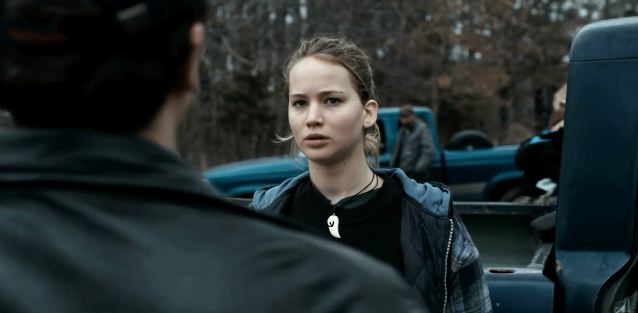
Immediately after I began watching Winter's Bone I noticed its excellent cinematography and lighting. Right off the bat the film gives off a creepy feeling with its lack of color. Even hues that are supposed to be bright are muted, and the overcast conditions set the mood even further. As a drama filmmaker, I definitely loved this aspect of the movie; there were several scenes when I was wondering if someone/something would pop out of nowhere and startle me. Compared to Crooklyn, our previous film, the setting is significantly more open and spacious (and creepy).
This film does, however, share some major similarities with Spike Lee's film, such as the role of the parents vs. children. When Troy's mother died, she took on her responsibilities, becoming the woman of the house. In Winter's Bone Ree's mother is alive, but she is mentally ill, leaving Ree to take care of her younger brother and sister. Another key component found in both works is the dysfunctional family situation. Troy's parents often argued, to the point where her father walked out on the family for a short time. The main focus of Winter's Bone is Ree's mission to find her father.
Everyone living at Ree's house is currently wedged between a rock and a hard place - if the father is not found and does not attend his trial, the family's house and land will be taken away. It's fair to say that he screwed them over by arranging this deal, listing the house as collateral for his bail. Worst of all, he is nowhere to be found as Ree goes on a wild goose chase in search of him. Everyone she confronts refuses to divulge a single word about his whereabouts, threatening to harm her if she doesn't leave them alone.
One of my favorite aspects of this film and Crooklyn is the realistic plots. All of the events that occur on screen are not a far stretch from what people deal with everyday, not just in the city but in the rural country, and everywhere in between. Poverty is not limited to urban neighborhoods, and I can already see that Winter's Bone displays this nicely. Perhaps one could even say that Ree's situation is worse than Troy's, because she doesn't seem to have anyone who's compassionate and caring to turn to in such a desperate time. Everyone she has met so far is uptight and downright mean.
I'm extremely eager to see how this film progresses. Will Ree locate her dad? What will he have to say? Will he just choose to run away and leave his daughter's family in ruins? Time will tell.
Subscribe to:
Comments (Atom)