Wednesday, April 4, 2018

Kit and Holly's Adventure


Badlands Dir. Terrence Mallick.
Feat. Sissy Spacek (Holly), Martin Sheen (Kit), Warren Oates (Father).
Warner Brothers, 1973.


As we continue to view celebrity/criminality classics we view Terrence Mallick’s 1973 film Badlands. As Aysia said, and I agreed, this movie is basically the “bootlegged version” most recently view: Bonnie and Clyde. When the term “Bootlegged” comes to mind, I think of something that is trying to portray something else, but fails to do so. Sometime bootlegged versions are awful, sometimes they are not. I would say that Badlands was not a terrible movie.

It was similar to Bonnie and Clyde based off of a few factors. In the beginning of both movies, both female characters (Bonnie and Holly) meet a “dreamy” guy who wants to runaway with them. Shortly after both male characters “explain” that they are not interested in the girls just for sex, but I think Kit kind of wanted some from Bonnie. Shortly after the movie began, Kit and Holly had sex in the woods. Furthermore, they eventually engage in a murder spree and eventual runaway. Both duos killed several innocent people along their journey. Bear in mind, these people did not know who the heck the fugitives were. Bonnie and Clyde killed a few police officers along the way; Kit and Holly killed a man in his own home, and a couple who they stuffed in a tornado shelter.

There were also some very large differences, between the two movies. Bonnie and Clyde were so into running away with each other, and were almost inseparable. That is different between Holly and Kit because most often Holly was very hesitant as to if she wanted to continue on their runaway. She kept asking to go home to Mama. Kit and Holly were very independent and did not want anyone accompanying them, but Bonnie and Clyde had a few. C.W., Buck, and Blanche (who I hated) all went along with Bonnie and Clyde. Perhaps the biggest difference between the two movies was in regards to the way they were caught. First off Kit and Holly were not together when the chase was over; Kit was by himself. Also Kit and Holly were captured alive, and extradited back to face a judge. On the contrast, Bonnie and Clyde were shot to death by multiple sheriff's. Bonnie was shot 26 times and Clyde was shot 17.

Overall, Badlands is a movie that I would more than less likely watch again. I am into the older movies and shows that involve criminality (Hawaii 5.0, and Walker Texas Ranger.) As I stated, this movie also had a lot of action to go along with it; I was often guessing what was going to happen next. I would recommend this movie to anyone who likes something old and country western, because let's face it none of what went on in Badlands would happen today.
kevin de jesus                                                              


                                                                           Creed

Image result for Creed

Directed by Ryan Coogler      
What’s in a name? The name you inherit, the one you give yourself, the one other people give you and the one you are remembered by: some of these are earned ,awarded and, others you fight against your entire life. The naming of names is the theme of the seventh film in the Rocky Balboa story, as the iconic hero solemnly defers to the legacy he has created, both directly and inadvertently, for younger blood with dreams of glory in the boxing ring. This film is directed and co-written by Ryan Coogler (“Fruitvale Station”), who so wisely and effectively creates the newest chapter as a crisis of self for the featured players who are caught between how they are perceived, how they will be remembered and the crux of identity in the midst of fame.
First of all, Coogler’s direction was brilliant, less from the perspective of the audience and more an out-of-body experience of the title character: the illegitimate son of late boxing champion Apollo Creed. We see Adonis Johnson (Michael B. Jordan) as he sees himself; we are in the vacuum of his mind as he struggles between the joy he gets from boxing and the anger which forces him to constantly fight. From the beginning scene of Apollo’s widow, Mary Anne (a fantastically poised and commanding Phylicia Rashad), asking the young Adonis from the confines of a cell in juvenile hall why he has been angry for so long, we watch the boy’s hand tighten to a fist and relax, as if he has to constantly find his core strength. Mary Anne takes the orphan home with her, as his mother has passed away and he has had to survive group homes and incarceration for most of his young life. She has seen the fame and glory bestowed on her late husband, and also survived the reality of his trainings, injuries and eventual death in the ring. Adonis lost Apollo, too, and that ties them together.
Fast-forward about 10 years and Adonis is an educated, ambitious young man rising up in his job. He is also a self-taught, cocky, hot-headed, impetuous fighter moonlighting in Tijuana matches. Like a gifted student satisfied with earning a C because he hasn’t been challenged yet, Adonis has won all of his 16 matches, but he hasn’t ventured beyond “barroom brawling,” as a trainer puts it. The rage Adonis handily keeps at the surface hides a potent fear of being abandoned (again), of being forgotten and of being someone’s regret. That underlying fear turns his hunger sour and more experienced fighters can spot his weakness easily through all the pomp and bluster.
Jordan’s visceral and magnetic performance show the steady pressure building inside his character that is equal parts Apollo and Rocky: he has the former’s bravura but lacks his polish, and his self-doubt and bullheadedness resemble the latter in his younger days.
Remember, in the first “Rocky,” Balboa was a loan shark and small-time hood, but not by choice. He wasn’t educated and had difficulty in social situations, preferring to lone it with his pal Paulie and playfully torment Paulie’s sister, Adrian, with terrible jokes. Rocky fought because that was his life, but he never sat easy on the throne the way Apollo did — he needed the security of the neighborhood and distrusted the politics of show friends and show business. While Adonis retains his father’s intelligence, he needs the approval of the community, of kids who see him on the street and in the ring.
As the specter of his father looms over his life’s dream, Adonis seeks out Rocky Balboa back in Philadelphia to try to figure out the man behind the myth. Like the HBO Sports episode that claims “people find hope in the tales of their heroes,” Mary Anne tells him the gritty details of a fighter’s life outside the ring, but only Rocky can tell him what was inside. Trying to convince the old bulldog, however, isn’t easy considering what Balboa has been through and lost. “Why would you pick a fighter’s life when you don’t have to?” he asks the young man, “I got other plans in my life. This wasn’t part of it.” Later on, we see how the older man is coasting very similarly to the younger.
Coogler doesn’t forget Rocky Balboa. He isn’t the main character here but he is the foundation for the young man’s future, and along with co-screenwriter Aaron Covington, Coogler continues the story of a life that has seen the zenith and the nadir of love, wealth and fame. Self-aware of his own strengths and limitations, Rocky Balboa feels his way through life as a means to overcome learning difficulties and lack of education. He can sense when someone is lying to him, when a good friend is around, when someone still has the hunger of the street and when a young man is afraid of everything crashing down.
Coogler absorbs Rocky’s knowledge of the streets and the community, the gym and the ring, the hunger and the fire, and creates three distinct rhythms swirling around and through Balboa, Adonis, and the girl downstairs, Bianca (Tessa Thompson). Not content as a plaything, sex object or girl Friday, Bianca is a fighter in her own right, creating and performing her own music with a ferocity honed through darkened clubs and basement dives, jostling for her place among the Philly musical greats. Thompson’s character employs the same no-nonsense drive on Adonis that Adrian did for Rocky and she has reason to run from regret. As the pace and the music of Bianca’s scenes are pounding but warm, thick and slow, we see the halting, pensive beats of Rocky’s rhythm in responding to people, either verbally or physically. He takes his time in answering and talks to himself, analyzing the situation and figuring the course. His theme music is stripped down to a single piano, illustrating the solitary life he has. Adonis leaps among all the different cadences as his training with Rocky and relationship with Bianca intensifies. The scene where the neighborhood kids surround and encourage him on their speed bikes is the pressure buster we have been anticipating and his exhilaration is our own.
Rhythm extends to the ring, as Maryse Alberti’s camerawork during Adonis’s fights is amazingly fluid as the sound reduces to the bare bones of the fighters’ interactions, echoing the adrenaline rush and instinctive drive when the human body is at its highest level. Rocky was right: Adonis has to fight himself and Coogler’s direction communicates this in a way that is heartbreaking when he gets down and joyous when he breaks through. This was one of my favorite surprises of the year. (A)

Monday, April 2, 2018

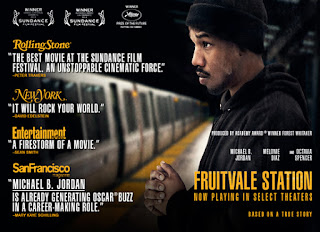
Fruitvale Station by Latrese

Image result for fruitvale station
Dir. Ryan Coogler

Starring: Michael B. Jordan (Oscar Grant), Melonie Diaz (Sophina), Octavia Spencer (Wanda)

Prod: OG Project, Forest Whitaker's Significant Productions
Distributor: The Weinstein Company, 2009

You never know what tomorrow brings and all you have to do is hope for the best. A movie based on a true story that could bring tears to your eyes. Oscar Grant was a young, African American man who was just trying to make it. He had a young daughter named Tatiana and a girlfriend named Sophina. Sophina only wanted the best for Oscar, especially for him to get a job since he lost the one he had. Oscar was in and out of jail throughout his life for selling drugs and once he was released, he wanted to start fresh. The movie shows flash backs of his time spent in jail. One scene showed his mother Wanda coming to visit him, she hated the fact that her son was locked up. Later on in that scene, his mother expresses that she wasn’t going to keep visiting him. She wanted her son to get his life together especially because of his young daughter. 

As the film went on, Oscar and his family attend a birthday party for Oscar’s mother. During the party, everyone is having a good time. You could tell that this is what his mother wanted. For her family to be together. Later on Oscar decides to go to San Franciso with his friends to attend New Year’s Party. His mother tells him to take the train to avoid driving. It was New Years day going back home, and on the BART train a big fight breaks out with Oscar and another former inmate. Police are called and the people involved in the fight were arrested. Police brutality has been a big issue for many years. While being arrested with his friends he tries to explain to the police the situation but the police start to physically abuse him. Many people on the train witnessed this and recorded every moment of this tragic moment. An officer turned Oscar on his back and had his knee lodged into his back. Oscar couldn’t breathe and there was multiple people screaming to tell him to get off. Then BOOM ! Oscar was shot in his back. 

This whole tragedy was recorded and it shows the innocence of Oscar Grant. This film showed the true colors of the abuse that police officers cause. Grant was trying to change his life around for the better, especially for his daughter. Sophina, his girlfriend stuck by his side after all he went through during his life. Seeing this movie really. was an eye opener to me, it showed the struggle of being a black person in this world. Not only with the police but financially and socially. I think this film should have been a little bit longer, It was quick but I enjoyed it. This film should bring a light to not only the struggle black people experience but the police brutality. When will it stop ? The fact that it was caught on film makes it even worse, you could visually see it and still today there is no justice. 


Wednesday, March 28, 2018

Chicago By: Henry Seyue

Image result for Chicago Movie

Director: Bill London
Starring: Renee Zellweger (Roxie Hart), Catherine Zeta-Jones (Velma Kelly), Queen Latifa (Matron Mama Morton) , and Richard Gere (Billy Flynn)
Producer Circle co., 2002

The Twenties are roaring in the Windy City, and Roxie Hart wants a piece of the action. Lights, live music, skimpy costumes and lots of background dancers: she has her sights set on stardom and she’d give anything to be like beautiful Jazz songstress Velma Kelly and see her name on the local marquee. She knows that her marriage to dopey, sweet, un-enthralling Amos won’t be her ticket to fame and fortune so she starts "fooling around" with other men. Fooling around leads to "screwing around" with Fred Casely, who says he’s got connections down at the Jazz club. Then she discovers that the only kind of connections on Fred’s mind happen between bed sheets, and she kills him off with her husband’s pistol. Ironically, she finds herself on death row at the women’s prison right next to the great Ms. Kelly, who has recently murdered her own husband and sister after catching them in an affair. The film provides a variety of positive elements, spiritual content, violent content and negative content which all add up to be the Oscar worthy formula that has made Chicago  one of the most revered musicals in Academy Award history.

In terms of the films positive element, through the media frenzy that Billy Flynn whips up, Chicago satirizes the ability of journalists to sway public opinion, tugging heartstrings and overshadowing the truth. The slick lawyer truly believes, "It’s all a three-ring circus—these trials, the whole world. It’s all show business." To sarcastically prove this point, one of my favorite musical numbers features Flynn as puppet master for a chorus of reporters, putting words in their mouths and telling the public exactly what he wants them to believe. Another musical interlude shows him tap dancing his way into the minds of the jury, not allowing them to think, but whipping them up emotionally until they’re eating out of his hand. At the height of the fame he creates for Roxie, one reporter announces, "She’s the sweetest little girl ever accused of murder in Chicago. Women want to look like her. Men want to date her. And little girls even want to take her home [in the form of a doll]." Though Flynn’s dog and pony show is overdone and unrealistic, the message is clear that our society allows the news media far too much control over our ideas about truth. It’s also easy to see that famous people are often admired and imitated just because they’re famous, and not because they’re worth emulating.

As far as the films spiritual and violent content goes, Roxie seems to have been raised catholic yet offers up half-serious prayers and directs flippant appeals to "Jesus, Mary and Joseph." A couple of times, Flynn stops her and tells her to trust in him instead. Flynn arrogantly proclaims, "If Jesus had lived in Chicago today, and if he came to me with $5,000, well, things would have turned out differently." When Roxie supposes aloud that her best bet is to tell the jury the truth, Flynn says, "The truth is a one-way ticket to the death house." This film is also one that Idealizes violence or at least puts it in a not-so negative light.  Although the crimes are stylized and not portrayed graphically (some are not shown at all), this movie is about murders and the women who commit them. Onstage, Roxie and Velma use fake Tommy guns to draw oohs and aahhs from the crowd. Offstage, Fred is shown shoving Roxie in the bedroom. She shoots him pointblank three times with a pistol. "Six Merry Murderesses" in the jail perform a whole number about how they killed their husbands or lovers. The theme of the song is, yeah, I did it, but it wasn’t wrong. ("He had it coming. ... If you’da been there, I bet you would’a done the same.") 

One female murderer is hanged onscreen [Was Hunyak actually a murderer?]. And Roxie’s crime is clearly the source of her notoriety. When she dreams of having her own vaudeville act after she gets out of prison, Flynn tells her that killing Fred is what will attract people to her show. "That’s all the audience wants to say—that they saw someone famous." Despite all this, the script also makes a point about how desensitized our culture is to violence. Roxie has to work hard to stay in the spotlight, since other women are killing their husbands and threatening to steal her fame. We see one other lady kill her husband and two women she finds in bed with him. Near the end of the film, an onlooker asks, "Roxie Hart. Didn’t she kill a guy a while back?" which she responds, "Ah, who can keep ‘em straight anymore?"

To conclude, this is certainly one of the more watchable musicals I've come across in my day. Sonically it may not be as pleasing as a film like Grease, but it still delivers pretty well and has more substance than a film like Grease. I liken this film to La La Land because I think they are very similar in the search for stardom that they both depict, I however think that La La Land was a lot more visually pleasing; however, it must be added that Chicago did what it could with the technology of the time. Again, in comparison to a film like La La Land I think Chicago wins in substance, the plot is seriously more thought out and the message is a lot easier to buy into subjectively speaking. It combines sex, violence, spirituality, law, positivity and negativity into a single story told through song. Overall I would give this film a a strong 7.8/10 with its biggest strength being either character development or plot, and its biggest weakness being is its songs.

Monday, March 26, 2018

Fruitvale Station: Michael B Jordan and Ryan Coogler joining forces is intense.


Image result for fruitvale station

Fruitvale Station (2013) is Ryan Coogler’s (director of Black Panther (2018)) first feature length film. This film focuses on the life and murder of Oscar Grant III in 2009.

  Coogler rouses empathy by introducing the film with real, un-dramatized footage of the event of Oscar’s murder taken by the pedestrians of Fruitvale Station. This changes the entire interaction between film and viewer. They might have been aware of the premise coming into the picture, knowing that the character Michael B. Jordan plays dies at the end of the movie. With this footage, Coogler forces you to immediately confront the real taking of a human life, establishing authentic raised stakes. This primes us to meet our unwitting main character with open arms, ultimately aware of his fate.

While this film only follows Oscar for a single day, the day leading up to his death, we get an intimate look at his entire history through the portrayal of his daily struggle. The daily routine is a basic but effective way to evaluate the priorities of a character in film. Coogler resuscitates this otherwise mundane model, keeping me completely entranced all throughout. The revival is due to every scene and interaction feeling intentional and meaningful, by introducing another facet of Grant's life and personality. Oscar’s difficult past is inescapable, haunting him wherever he goes. I found this accurate to how people clasp onto their trauma, especially those from a crime ridden lower income area, as they are more likely to face strain early in life. Oscar was once incarcerated, and has since struggled to keep a job at the local grocery store, and keep away from the temptation of selling drugs for financial support.

Thematically, it is a simple instance of the complexity within every human being otherwise unseen and disregarded by strangers. It brings humanity into a man whose life was cut short without reason, one of millions who die young constantly. I found myself really empathizing with Oscar based on his actions, even though I think that certain interactions were inflated. Some things were glaringly untruthful. One of these instances is Oscar watching a dog get hit by a car, to run to it and comfort it in its dying moments, and then leave the dead dog in the street. While he was unobligated to do anything with the dog’s body, it still felt wrong to see a dog treated as roadkill within a movie. My disbelief that was previously suspended rose back to me, upsetting me. As much as I liked Oscar’s character, I thought the more realistic actions of kindness with his daughter, his girlfriend, his friends, and strangers were sufficient. I found this manipulative and annoying.

Coogler defends himself, admitting: “ While Grant never had such an interaction, Coogler’s brother did, and upon hearing the story Coogler saw that it fit in thematically with the story he wanted to tell. “He told me that he was at a gas station and had an interaction with a dog then saw that dog get hit by a car,” Coogler says. “At that moment I thought about Oscar. I thought about all of the black males who die in the street and life goes on.””

I embrace this symbolic meaning, but I still hate to see a dog suffer :(


Overall, a very moving film, and more reasons to love MBJ and Coogler. 

Friday, March 23, 2018

Chicago-Stephen Collins


Chicago is 2002 Best Picture winner musical directed by Rob Marshall and stars Renee Zellweger, Catherine Zeta-Jones, Richard Gere, John C. Reilly, and Queen Latifah and based on the play of the same name.


Chicago take place in 1924 in the titular city where Roxie Hart murder her husband and sent to prison for her crimes along with Velma, who also murder her husband. Velma is a performer and Roxie inspire to be one. Roxie becomes a star and their a bunch a musical numbers.


Chicago is a good movie but I don't if is a faithful adaptation. I never seen the play but my Mom is seeing it soon. I assume so because it is romanticize. It not too romanticize, unlike the remake of The Great Gatsby which was romanticize down to it production design.


The acting in this movie is good. They did a good job. Catherine Zeta-Jones won Best Supporting Actress that year and Latifah also was nominated.  Zeta-Jones and Latifah are probably the best two performances. They give great performances in the film. The other performers are great, Zellweger, Gere and Reilly.

I was more into the direction in the film. The choreography is the movie is great and it is done incredible well and the musical number are great. The direction is great, too. Marshall does a great job and is now doing Mary Poppins and Emily Blunt look amazing is that.


One thing I thought I would love are the songs. The songs are good and the musical numbers are great but I like musicals, so I thought I would hum these songs for weeks. I haven't seen The Greatest Showman yet, but the soundtrack is amazing. The musical numbers are great, like when they're performing "We Both Reached For The Gun. That is a great number. The one thing I think the film does a great job of is that it makes it clears that the musical numbers are not happening in real life.


I also thought is ended it abruptly. I was expecting more, but the story ends. The case ends and it mostly a story about a person 15 minutes of fame.


Chicago is good film. It's a great musical, has great songs, really good performances and great great choreography and direction. I seen it again.


chicagNO-Tommy Avila

Related image


The movie Chicago is a 2002 Academy Award-winning film made by Rob Marshall and stars [shift in tense] RenĂ©e Zellweger as Roxie Hart, Richard Gere as My personal favorite character Billy Flynn, Cathernine Zeta-Jones as Velma Kelly, and John C. Reilly as Amos Hart

The film starts out in a club [The Onyx] with a woman rushing to get on stage after they can't find the second part of her act (Hher sister). The show goes on anyway, and it shows a woman in awe with a man by her side. The man convinces her that he has connections to the club and can get her on the stage. She believes him so she can follow her dream, and she sleeps with him. After she keeps pestering the man named Fred Casely he reviles [reveals] that he doesn't know anyone in the club and doesn't have a connection. After woards she gets thrown he pushes her into a dresser, and Roxie Hart grabs a gun from her dresser and shoots Fred Casely. Roxie is then interrogated and tells her husband whom she was cheating on to lie for her [this is confusing as written]. Eventually she breaks and the husband snitches. Roxie is then taken away to prison and makes headlines. 

In the prison she meets other prisoners who are there for the same [similar would be more precise] crime. They all killed their husbands for certain reasons but the most important one is the singer Velma Kelly because Roxie Hart looks up to her as a performer and was there at the club the day she was arrested. 

I don't remember why Velma killed her husband, but I can only assume that he cheated on her. During this time Amos is trying to get a lawyer and Roxie finds out about Mr. Flynn who has never lost a case. Amos then gives him all the money he has, and Mr. Flynn takes the case. At first Roxie wanted all the attention and Mr. Flynn realized he could capitalize on her looks and singing for media exposure to tip the case in his favor. He tells Roxie to listen to what he says and follow all his steps. She is essentially a puppet, and the film in its strongest and most entertaining musical number shows this quite literally in one of the songs where - they make a cover story that she was defending the house, and they both "Reached for the gun." After this the media in Chicago eats it up, and they all love Roxie. 

Eventually she starts falling off and needs more attention so she can get her lawyer back and get her spotlight to keep her newfound fame. She pretends to feint [spelling  -  also a great opportunity for both alliteration and pun  -  she feigned a fainting spell LOL] and says"I hope I didn't hurt the baby!" Everyone eats it up. Eventually she gets her case and the Lawyer Flynn makes a fake diary and writes phrases that sound like the apposing lawyer is tampering with evidence. The case is won and he is held with contempt.In the very end Roxie and Velma start a two woman show and the movie closes .

Personally I thought the movie was ok but a lot of the songs felt like filler and had no place or structure. the movie is structured like a play or musical and while I am fine with that the movie seems to cut corners in the music department making it unbearable for me to hear.