Tuesday, September 30, 2014

Man On Wire: Reaching For a Dream


In all honesty, I wasn't very interested in "Man On Wire" in the beginning. The visuals weren't very appealing to me and I found the plot to be very slow. But as the movie progressed, I started to become more engaged in Philippe Petit's story and the way it tied into our studies of the "American Dream." Similar to "Rocky" and "Sugar",  Man on Wire focuses on a young Frenchman named Philippe's dream to tight rope across the Twin Towers in New York City.

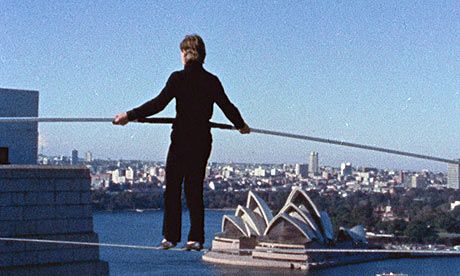
The beginning of the documentary creates a mood of suspense as Philippe and his crew sneak into the World Trade Center with fake documents. But before the viewer sees the plot unfold, the documentary delves into Philippe's early life in France and how his dream manifested over time. We see clips of Philippe practicing on the tight rope with his girlfriend and Philippe walking across the Sydney Harbour Bridge in Australia. Pictures are also shown of Philippe tight-roping across the Notre Dame Cathedral in Paris. The epiphany moment in the documentary was when Philippe was waiting in the dentist office and he saw the picture of the Twin Towers in the magazine. He quickly ripped out the picture and fled the dentist office with a newfound dream to travel to Manhattan and tight rope across the Twin Towers.

We have discussed the "American Dream"and the "Underdog" numerous times in class. In "Rocky",    Rocky Balboa was the inexperienced, "southpaw" in the boxing match against Apollo Creed. In "Sugar", Miguel was the newcomer to America, trying to make his way in professional baseball. In this documentary, Philippe is an underdog in the sense that not many people support his dream and believe that he is reckless and crazy. With "the Establishment" against him, Philippe has to plan carefully with a few trusted individuals to get into the World Trade Center and walk across the towers. In the documentary, one of Philippe's accomplices stated, "What we were doing was illegal, but not evil."

I am very curious to see how Philippe's story will continue to unfold as we left off where he was hiding under the tarp at the top of the World Trade Center, while the security guard was snooping around. Will Philippe be able to fulfill his dream? At what cost?

Monday, September 29, 2014

Life on the Edge

While watching Man on Wire, I initially thought that Philippe was crazy for trying to perform such a dangerous stunt: to walk on a thin cable that stretched from one of the World Trade Center buildings to the the other one. But then I also didn't see the big deal with crossing such a wire, and quickly became bored with the documentary. But then shortly after it ended, I realized something greater: it's not necessarily about what Philippe did when it comes to the task, but more about the triumphant nature of it. In other words, what matters is the fact that he accomplished this task, which is definitely not easy to do. A million and a half things could've gone wrong: he could have fallen hundreds of feet to his untimely death, for instance. There could have been an issue with the cables; what if they weren't tied down well enough to support his weight?

This all ties in to risk-taking. Life is about taking risks and challenges. Nothing is certain in life for anyone, regardless of your income, ethnic background, gender, or any other characteristics. You can either be successful, or fail. It's part of the American Dream. People who are living the American Dream didn't just stay within the confines of their comfort zone their whole life. They didn't just do whatever was "easy" for them. Philippe fits this description perfectly. He was living the American Dream, capturing the world's eyes with his daring stunt. Much like with Sugar and Rocky, Philippe faced a lot of adversity, but that didn't stop him from, as Rocky said, "going the distance". Literally.

I was amazed as I watched him walk on the rope, and even lie down on it. I wonder if he was afraid at all, if he was nervous. It had taken so much time to set up the rope, but it was all paying off. That's another important aspect of the American Dream: patience. It takes time and patience to achieve your goals, you can't do everything overnight. Success may not come quickly, but it's worth the wait. Learn to value the process, not just the result.

Thoughts on Man on Wire

Man or Wire seems pretty interesting so far. I'm not really a fan of documentaries but I have seen a few that I really liked. In this film, Philippe Petit's dream is to high wire walk across the Twin Towers. He has loved to climb his whole life. He seems pretty confident and set on doing it, even if he is doing something illegal. It's pretty crazy that someone would do something so risky and at that height, especially when one mistake could cost him his life. I'm excited to see him make it across. I'm also really excited to see what movie we are watching after this because since it's October we will probably start watching horror/suspense movies, which are my favorite.

Shawn Luzzi: Man on Wire First Impressions

Man on Wire First Impressions

Shawn Luzzi

For our first documentary we're watching in Film Studies, this particular film is interesting, especially in who the movie is chronicling, Philippe Petit. Philippe is best known for the famous high-wire student across the twin tower roofs, and for himself being a high-wire artist. When watching the film, it was particularly interesting to see that Philippe seem to not be afraid of the enforcement officers that would come and arrest him for what he had done. That, and Philippe always seemed to do these stunts in the most populated places, along a bridge, then along two tower roofs. 

A bit of text on my part, Philippe is definitely a trained and brave man. Especially when he has the bravery and practice to be able to merely lay down on the wire without slipping off the wire, that, and do other small tricks while on the wire such as juggling. 

Thursday, September 25, 2014

Final thoughts on Sugar

As we continued the film, Sugar was still struggling and even resulted to using drugs to play better. This didn't really make his situation better and no matter how hard he worked it became too much pressure for him so he decided to quit and move to New York where he got a new job in a restaurant.
This ending of Sugar left me wondering about what's going to happen to Sugar in the future. I was a little disappointed in him for quitting his dream to play major league baseball. I wasn't expecting the movie to end the way it did. I was somewhat confused at first at why this happened. I thought he would end up going back. However, this film shows a more realistic ending. In reality, not everyone can always be the best and achieve their dreams. Sometimes you try your best and you still don't succeed. Also even though he didn't end up as a huge major league baseball player, he continued to play by joining a local baseball team at the end of the film.

Wednesday, September 24, 2014

Shawn Luzzi lasting impression of sugar (Spoiler yo)

Shawn Luzzi: Last Impressions of Sugar

Watching the rest of the film, I was satisfied with the small amount left in the film and its ending. At first, it seemed that Miguel would forever give up on this baseball career over mishaps that had happened during the season, and that he would spend the rest of his life working in New York. However, after a handful of events, such as a talk with his own mother. Miguel started to straighten up, and go back to pursuing his baseball career by simply joining a new team. 

I felt satisfied with this ending as for one: this isn't a standard "Hollywood" ending, there was no big game or anything that Miguel came close to losing that had happened in the film. The conflicts that had happened were more realistic rather than fantasy. Second and lastly, Miguel is able to continue his baseball career, despite his past mishaps.

Tuesday, September 23, 2014

The Journey

Last class, we had our final viewing of Sugar. From the beginning of the movie to the end, I saw a common theme: struggle. Miguel "Sugar" Santos came from the Dominican Republic, an impoverished country, to the United States in hopes of becoming a successful baseball player. In my previous post, I had mentioned that this aligns with the American Dream. However, I also mentioned that, in order to achieve success, one must work very hard, and adversity is an inherent component. This theme perpetuated throughout the entire movie. Sugar found out very quickly that the road to success has many bumps and turns. There are a lot of wrong decisions that could be made when the pressure is on. Sugar decided, like numerous athletes have, to take steroids (Speed) in order to boost his performance. However, this didn't work out so well for him, as he quickly learned.

It wasn't long before Sugar had given up on baseball, frustrated by his poor performance in the game. He travelled to New York City, and got a job as a busboy at a diner. I found it very disappointing that he had quit baseball, since that was his whole reason for coming to the United States in the first place. Back in the Dominican Republic, he had done so well, what was the problem in America? I think the reason why is that it became overwhelming for him. It was different from where he had grown up. I began to understand all of this, and realized a key component of the American Dream, and life in general: it is not about winning, but about giving it your all. As Rocky Balboa said, all he wanted to do was to "go the distance". Even though he had not won the fight, he achieved something much more significant. He had done something that he never thought would be possible, and that in itself is an example of success. I can relate Rocky's experience to Sugar's in this respect. Sugar didn't become famous by any means, but he definitely went the distance. Sometimes, it's not about achieving your goals, but about giving an earnest effort. No one can win everything; it's unrealistic to even think so. 

Sugar's move to the United States wasn't a complete waste either, since he did get that job at the diner, and met a guy named Osvaldo, who helped him make a table, which he had promised would be sent home to his mother. Being that he's so young still, he has a lot of potential, but he just has to start small, and work his way up. That's what life is all about.