Wednesday, December 6, 2017

The Rednecks #domdemilo


Winter’s Bone Dir. Debra Granik
Jennifer Lawrence (Ree Dolly), John Hawkes (Teardrop), Garret Dillahunt (Sheriff Baskins), Dale Dickey (Merab)
Roadshow Pictures, 2010.


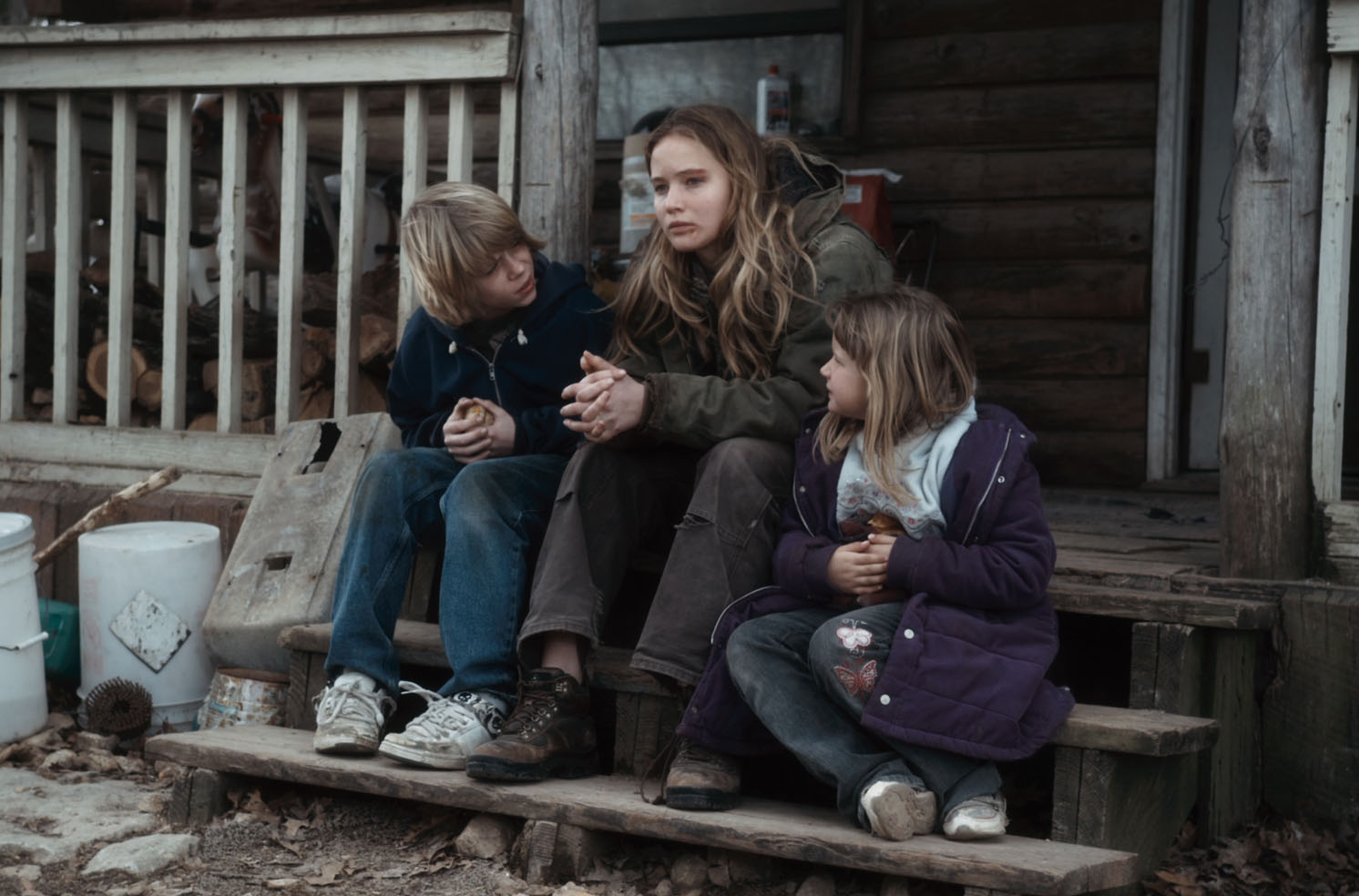
Debra Ganik’s 2010 film Winter’s Bone entails a family who is broken. Jennifer Lawrence (Ree Dolly) lives in the typical “backwoods” “redneck” town with her two younger siblings and her sick mother. Her father is absent from the film because he is supposedly either dead, or in prison for allegedly cooking up crack and methamphetamine. Instead the father figure in her life is her uncle who is commonly known as “teardrop.” Now teardrop might seem like the father figure in Ree’s life, because he is the only older man who she can go to if she needs help, but he does not portray a sincere and loving father figure. At the beginning of this movie, teardrop advised Ree to not go out and ask people if they know her father’s whereabouts, but she did not listen. From beginning to end, Ree does everything she could to protect her brother and sister.
One day, as Ree was outside in the front yard, she was approached by a sheriff who came to inform her that if she could not find her father or prove that he was dead, her family’s house would be put on the market. Ree would not back down; she had to do everything to save her family. She did everything alright. Ree went through hell and back along her journey to find her father’s remains. She went to a woman Merab who was her cousin, and asked to talked to her husband who advised her to stay away from the property, or else there would be trouble. She followed her orders and went home. Later on, Ree’s cousin came to talk to her, and he told her that if they did in fact lose the house he would take one of her siblings in, and their other cousin would take the other. Ree hated the idea, and voiced her displeasure, and then continued on her journey of desperation. Ree eventually went back to Merab’s property. She was met by her and her sisters who hit her in the face with some type of sharp object, and stomped on her once she fell to the ground. All the sisters took the bloodied Ree into their garage where the whole family gathered to talk with her.
Someone came to rescue Ree and take her home. Surprisingly that person was Teardrop, the man who swore at her and smacked her in the beginning of the movie. At this point in the movie, everyone knew that Jessup (Ree’s father) was dead, and teardrop told her that if she finds out who killed her father, not to tell him because that would infuriate him, and he would then kill his brother’s assassin. I could see Teardrop doing this, because he was stopped by a cop with Ree in the car, and when the cop approached the vehicle teardrop had his gun ready to shoot. In short, teardrop was a savage, and gave no f****; when it came to his family, he had their back.
Time was money, and Ree knew that she had to find her father’s bones in order to save the house. Merab and her sisters –the ones who previously beat Ree–  scame to the house and said they would take her to where the father’s bones were. They took her to a deeply wooded area, that had a lake in the middle of it. Ree then found where her father’s body was and cut off both of his hands. Within 24 hours Ree went to sheriffs office to prove to that her father was dead.
Ree’s mission was a success, and the family was allowed to remain in their house. In addition, the sheriff told her that when Jessup was in jail someone paid off part of his bond, and that the leftover bond money was now Ree’s to use to support her family. Although we did not find out who the father’s killer was, I believe it was Merab’s husband. The first time Ree went to the house, Merab immediately pushed her away. Then, when she was brought to the garage, he was the first one to say “I do not want to be here when he gets here.” He was referring to Teardrop. You can assume that he does not want any contact with teardrop, because if he killed him and teardrop found out, well he is dead meat.
Throughout the movie, Ree was portrayed as the "female protagonist." She acted as the father like figure for her siblings, and she would not let them or herself down. Ree did let her ego over power her along the way though. She was often very arrogant, cocky, and did not think before she spoke. This is why she fell into trouble with both Teardrop and Merab. I would definitely recommend this film to someone, because at first, it might not seem like an intriguing watch, the action did come around. You also learn a valuable lesson from this film: do not let your ego speak for itself.

Family Values in Ozarks

Director: Debra Granik
Writers: Debra Granik (screenplay), Anne Rosellini (screenplay) 
Stars: Jennifer Lawrence, John Hawkes, Garret Dillahunt

Winter's Bone is a 2010 film that depicts a young woman's determination to keep her family together. Caught almost literally between a rock and a hard place, Ree Dolly’s (Jennifer Lawrence) life in the brutal yet beautiful Ozarks, an unyielding stretch of south-western Missouri, is one that would test the hardiest teenager. Her father’s only bankable skill is his ability to cook meth and he’s long gone, leaving her to care for her glassy-eyed, emotionally hollow mother and her younger brother and sister. His court date is due, and if he fails to make good on his bond and show up at court, they’ll be homeless and left to suffer. This sends Ree on a treacherous journey filled with boldness, beatings, and druggies in order to find her father and restore the security of her family's home.

       One important theme is one we discussed in class. "Norms" and "Taboos". An evident norm in Ozarks is that everyone minds their own business and things are kept on the hush. Also, women don't seem to really have a large voice here. Ree breaks these norms when she goes around looking for information on her father, Jessup's, whereabouts. She goes door tapping and searching for dangerous men by herself searching for answers. This even earns her a good beating once. When she does this she is performing a "taboo", or going against the norms. This film really exemplifies this theme.

       Addiction is part of the scenery in Winter's Bone as well. Almost everyone in the little mountain community is smoking or snorting something. When Ree confesses to a neighbor that her father was cooking crank, the woman replies, "They all do now. You don't even need to say it out loud." Drugs are so pervasive that offering them has become a common backwoods courtesy, like bringing food to a sick neighbor. After Ree's uncle, Teardrop (John Hawkes), balks at helping her, his wife presses a joint into her palm and apologetically tells her, "Here's a doobie for your walk." Little Arthur, her father's pal, turns her away completely. "You want a line?" he asks. "You want to blow some smoke?" She doesn't. "Then I guess we got nothing for you! Go on!"

     Overall, most movies of such cultural crisis will call up a hero who can, with sharp shooting, cleverness, and relentlessness, overcome the villains. The hero’s motivations and convictions are usually forgettable the story’s just an excuse for wild stunts and spectacle. Thoughtful storytelling and character development are a surprising bonus if they occur at all, but Ree’s a far more human hero, distinguished by her selfless courage. Her actions are about identity, not excitement. Nothing here happens for the sake of a gratuitous thrill. Everything is rooted in Ree’s love for her family, and this was the most enjoyable part of the film for me.

Winter's Bone

Granik, Debra. “Winter’s Bone.” (2010)
Jennifer Lawrence (Ree Dolly), John Hawkes (Teardrop),  and Dale Dickey (Merab)

As an adaption of Danielle Woodrell’s 2006 novel, “Winter’s Bone” explores many themes through one 17-year-old journey to find her drug-dealing father. Ree Dolly is forced to be the primary caretaker of her mentally ill mother, 12-year-old brother, and 6-year old sister. She tries her best everyday to make sure they have something to eat, something to drink, all while teaching them basic survival skills because no one knows what tomorrow may bring. Ree’s father, Jessup, has been gone for some time and is nowhere to be found. He’s out on bail following an arrest for manufacturing “crank,” a strong CNS stimulant. Sheriff shows up at her doorstep threatening that if Jessup doesn’t show on his court date, then they will lose the house because it was put up as apart of his bond. Ree sets off determined to find her father, following his footsteps into the world. She encounters many things a typical 17-year-old wouldn’t even think of, such as common drug use, frequent violence, and people who are brought together through loyalty and secrecy. She starts with her Uncle Teardrop, who is addicted to meth and marijuana. She then venture out to find further family and close friends who might be able to help find her father which brings her to their local crime boss, Thump Milton. He refuses to see here and the only information that Ree can come out with is that Jessup dies in a meth lab fire. When he fails to turn up on trial day, a bondsman comes to tell Ree she has about a week before the house is no longer theirs. Ree, who thoroughly believes that her father is dead, swears that she can prove her family passing before the house is gone. Ree tries to see Milton again but is beaten by the women of the family. Teardrop rescues Ree and tells her predators that “she won’t say anything to anyone.” A few nights later, her attackers come by to help Ree, telling her that they will take her to her father’s body. They take Ree out in a rowboat o a shallow area where her “daddy’s bones” lie. They make her reach in to grab both of his hands and they use a chainsaw to dismember the extremities and put in a burlap sack as proof. Ree takes them to Sheriff saying someone flung them on her porch recently.
This film explores many themes, from your ego, to family ties, to being alone and being a female in a man’s world. Ree was a strong protagonist from the beginning. She’s taking the place of mom and dad, for both figures are absent. She further fulfills the father figure by venturing out to find out about her father, enduring physical and emotional pain. Her ego almost consumes her, for at one point in the film. Her neighbors offer to raise one of her siblings to which she quickly shuts down. This was not the best decision in my opinions. However, she’s quickly put back into place as a woman, for many men recognize her courage and remind her of where she stands in comparison to them. Blood is bloods, and typically that means there’s inferred respect. However, in this movie, it seems that family ties don’t mean a thing, for when Ree crosses a line, a relative, like Uncle Teardrop, is quick to choke her and remind her that crossed the line.

The film wasn’t particularly my favorite so it wouldn’t be my first to recommend. Indie film drama mysteries aren’t necessarily my favorite movie genre.

Monday, December 4, 2017

Jonah Nazier Galan- Winter's Bone

Related image

Winter's Bone Dir. Deborah Granik
Feat. Jennifer Lawrence (Ree Dolly), John Hawkes (Teardrop), and Garrett Dillahunt (Sheriff)
Roadshow Pictures, 2010


On June 11, 2010, the debut of Winter's Bone occurred. With an absent and missing father and a withdrawn and depressed mother, 17 year-old Ree Dolly keeps her family together in the dirt poor rural Ozarks. She then faces a life changing conflict when the local Sheriff Baskin tells her that her father, Jessup put up their house as collateral for his bail and unless he shows up for his trial by next week, they will lose it all. Having prior knowledge that her father is involved in the local drug trade and manufactures crystal meth, she goes on a hunt for him. However, everywhere she goes the message is the same: stay out of it and stop poking your nose in other people's business. She refuses to abide, even after her father's brother, Teardrop, tells her he's probably been killed. She continues, putting her own life at risk, for the sake of her family until the truth, or enough of it, is revealed.
The film commonly know as the adaptation of Daniel Woodrell's 2006 novel, presents many moments that drew my attention for analysis. As the film's opening scene begins with a lone women singer and dull color pallet, it gave prior insight as to the tone of the film. It told me the movie would be slow paced as well as a reference to the setting, country area in the woods. As the movie continues, we are then presented with Ree Dolly giving her horse up to her neighbor to take and nurture as she is incapable of doing so due to lack of funds. This was our first encounter with I presume to be her guardian angel or mother figure. Another but ironic guardian angel of Ree’s is her very own Uncle, Teardrop. When are was jumped by Alice and her two sisters, and taken to the barn, Teardrop was the one to send her free. During that scene it was set up as a one versus many duel, however there was a sense of Teardrop having the leverage. The reason for my analysis is that there was intimidation and fear of the many. Even as Thump’s posse being armed while Teardrop was vulnerable, they still feared upon the man.
One theme we discussed before and during the critical viewing of this film is that of norms and taboos. It is evident that dealing with narcotics is the norm to make money and survive in Ozarks of Missouri. Another norm that is repeatedly stated to Ree Dolly is to not poke your nose into anybody's business, however, as stubborn as Ree Dolly is she commits a taboo. Constantly breaking this rule. even after her uncle Teardrop (played by John Hawkes) reveals that he might have been murdered. Ree confronts this local norm and becomes a strong female protagonist through that and her ability to raise her siblings on her own. She also acts as the provider of the house which is traditionally the man of the household, however have a non-responsive mother and a missing father, she must fill that void. This can be seen through many occasions throughout the film, from Ree chopping the wood, providing food on her siblings plate, holding all responsibility for the household, and importantly finding a solution to the big issue. I would describe her as the black sheep or taboo of the movie as she opposes many of the neighborhood's norms and wishes. Another norm that was prevalent is that men are held more superior than women. This is seem in multiple occasions from Teardrop commanding orders from his wife and choking Ree Dolly for not listening and wanting to risk her life for answers.
One scene throughout the movie that caught my eye was the short black and white clip of the squirrel and birds in the woods, with chainsaws echoing, as they cut down the trees. This presented symbolism. The chainsaws cutting down the trees, are taking away the squirrels and bird home from them leaving them to in a corner of vulnerability. This can be seen as  Ree Dolly and her family as the animals and the Justice system and bailsman as the chainsaw slowly chipping away at their home as time progresses slowly leaving them with nothing but vulnerable.
For the closing scene, when Teardrop comes to a realization of who Jessup Dolly’s killer is, it lead to much speculation. Personally, I feel that Teardrop himself had kilt his own brother. I say this because The neck tattoo that he had looks to be the mark of Cain, linking back to one of the oldest stories of fratricidal jealousy. It may explain why Teardrop, has a volatile and ruthless nature. This helps explain how Ree recognizes this truth at the end of the film by offering Jessup's banjo to Teardrop to keep, which he then briefly picks and hands back, saying his brother was always better. As he leaves Ree's porch, Teardrop then claims he knows the killer after all.

Friday, December 1, 2017

Man on Wire (2008) - Jack O'Brien

Man on Wire (2008) is is a British Noire Documentary that follows Philippe Petit's famous wire walk of the twin towers in 1974. The film was nominated for, and won the 2009 Academy Award for Best Documentary. The film was directed by James Marsh and based on the book of the same name by Philippe Petit.

The film is at heart, a documentary, because of this, it is difficult to evaluate its themes. Any moral ambiguity the characters posses are real people, these are their real motivations and justifications for their actions. The real note here is that Philippe and his cohorts make no attempt to justify. They understand the illegality in their actions, but they explain that they pressed on in the name of art.

Petit's stunt was dangerous, and in a way, beautiful. The way it is presented throughout the course of the film lends the viewer to believe with impartiality that it was a work of art rather than a crime. The Noire presentation of the history, panning, and execution of the long-winded and long anticipated feat of wire walking the Twin Towers lends viewers to see this as a secret, beautiful thing, rather than what would be called in today's world an act of terrorism.

I don't think there is much else to say. I believe that Petit's act was beautiful. I think that the documentary frames it as such and does it well. Man on Wire is well deserving of its Academy Award and hopefully becomes a classic.

Thursday, November 30, 2017

Alien By Shanelle Lester


The 1979 movie Alien featured an interesting, story filled with plot twists and betrayal  survival and leadership were put to the test. Each of the characters has their own responsibility that they have to attend to. Each of them will have to learn to stay in their own lane handling what they came on the ship to do and not get in the way of anyone’s else's job. This movie featured the characters of Ripley (Sigourney Weaver), Kane (John Hurt), Parker (Yaphet Kotto), Brett (Harry Dean Stanton), Lambert (Veronica Cartwright), Dallas (Tom Skerritt), Ash (Ian Holm).
The crew members of a commercial starship Nostromo are awakened from their cryo sleep capsules halfway through their journey back to planet earth. They were woken up to investigate a “distress call” from an alien vessel  -  I use quotes here because it is later revealed that it was a warning sign to stay away and that they were purposely sent there by the Weyland-Yutani Corporation. While going to investigate what they think is a call for help but really is a warning, they run into a rough landing on the moon which calls for the ship to be fix. Three of the crew members had went off the ship on the moon in search to find the distress call and help. The movie starts to take a drastic turn when krane discovered a neats full of eggs with aliens in them. The egg starts to hatch and jumps on the crew member face leaving ripley to have to make a hard decision of leaving him to die for the safety of the other members. Eventually ash opens the shuttle letting them inside, once krane has recovered and they thought that the alien had died everything went back to normal ash was a hero was letting krane back inside to save him. But instead he made a decision which put everyone in danger. During lunch krane has met his death when the alien popped out of chest. Along the way one by one they all met their death. One minute they're alive trying to survive and the next their dead without a trace. Ash was loyal, he wouldn’t let krane die, we went against ripley orders to ensure that they can get the alien off of krane face. We were wrong ash was a robot who knew all of this was going to happen. He went against them leaving everyone to die but one. Ripley was the only survivor.  


Tuesday, November 28, 2017

Planes, Trains, and Automobiles

       
Hughes, John. “Planes, Trains, and Automobiles.” (1987)
Steve Martin (Neal Page) and John Candy (Del Griffin)

Talk about stranger danger! In this brief holiday classic, Neal Page (Steve Martin) is just trying to get home to Chicago to see his wife and kids in time for Thanksgiving, although this soon becomes a much more difficult task. As his misfortune continues, public transportation seems to fail him in great magnitudes and finds himself desperate just to find a place to stay for the night, he ends up having to follow a man that stole his taxi that same morning Neal is forced to bunk up with the extremely talkative Del Griffith (John Candy), whom he finds deathly annoying. Although the close bunking he shares with the man is not nearly the worse experience he would have in the following days. He goes through trials that comes with the insanity of the holiday season tied along to a man he can not stand, but while going through this process the two unlikely friends share a few laughs and stories. By the end of the film Neal is more than ever ready to go home, he gets on the train and starts his journey. He has no watch, no money, no phone, and most of the clothes off his back had disappeared, but realization soon hits him as he notices that Del was not actually going home. The irritating stranger he had come to know was not able to return home to a huge Thanksgiving feast, he had no one to share his joy of survival with. With this realization in mind Neal brings his new friend back to have a meal with his loving family.

The relationship that is shared between the two is immense, and this quickly became more than just two guys trying to make it back to Chicago, it is a heartfelt story  of sharing love and joy not only in the winter months, but all year round. If anything should be taken from this movie, it should be the fact that a person is not how they appear, there is more to everyone then what they show. In this case, the large taxi stealing, shower curtain rings selling man who seems very disorderly and messy, but he is actually just a poor lonely widow.