Monday, March 9, 2015

Rebel Without A Cause: 1950s Teen Angst


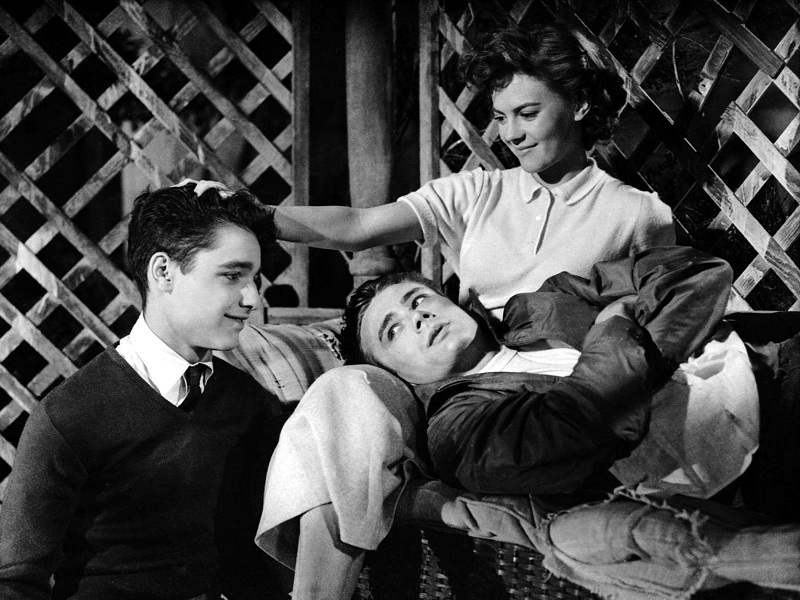
Out of all the films we have viewed in this class, Nicholas Ray's "Rebel Without A Cause" (1955) is one of my favorites. Interestingly enough, it is the oldest movie we have watched. I really liked this film because it addressed a lot of issues that teenagers face, primarily the pressure to be accepted by family and friends. I was surprised that issues like these would be addressed in a film as early as 1955. The cast of this film is simply legendary: James Dean (Jim Stark), Natalie Wood (Judy), and Sal Mineo (John 'Plato' Crawford).

The main character of the film, Jim Stark, moves to a new town and  has trouble fitting in. In his family, Jim's mother is the agressor and tends to boss around his submissive father. Everytime Jim gets into trouble with the law, his family quickly sweeps the problem under the rug, primarily by moving from house to house. While adjusting to his new surroundings, Jim Stark develops relationships with both Judy and John who are struggling with similar issues at home. Judy is basically ignored by her father and tries her hardest to get his attention. John is a lonely, fragile individual from a wealthy home in which he is under the supervision of his maid for the most part. After a game of "Chicken" against popular guy "Buzz" to prove his worthiness of getting into the "in-crowd", Buzz drives off a cliff and dies. 

Subsequently, Judy and Jim retreat to an abandoned house, in which John followed them. For a brief moment in time, the trio escapes from the pressures of the real world and runs around the house like young children. This moment of happiness is interrupted when Judy and Jim leave a sleeping John alone for a brief moment. Unfortunately, this is when Buzz's friends decide to interrupt their party. Out of fear, John's starts shooting at them and goes into a panicked state from being left alone. Once the police arrive, John becomes even more distraught and Jim takes it upon himself to calm him down. Jim is able to convince John to let him see the gun and takes the bullets out. At the climax of the film, Jim tries to get the police to turn off their lights as they are disturbing John, but they don't listen. John pulls out his empty gun to shoot and immediately the police start shooting at him. John is killed, and the film ends with a crying Jim as John's body is being carried out on a stretcher.

I believe that this movie is particularly powerful because it encourages young people to be compassionate to one another, and essentially "do what is right". In the film, Jim's parents never allowed him to be accountable for his actions. Jim defied this by going back and trying to help John because he understood what it felt like to be abandoned. Eventhough John's life was tragically ended, Jim tried his best to help someone who desperately needed a friend. I think we can all learn a powerful lesson from this film. 

Michelle Ford- When We Were Kings


Opposed to the documentaries we watched in this class, this was the only one I liked because I really wanted to learn and know more about the fight between champion George Foreman and Muhammad Ali. This documentary explores the relationship between African-Americans and the African continent during the Black Power. In the documentary, I noticed Ali was doing a lot of "talking" about Foreman. Maybe because he knew he were going to win. Foreman didn't have much to say, unlike Ali. I liked how Ali was talking about winning because he proved his point and just didn't talk about him winning. Some people just talk about things, but don't never accomplish it. 
Boxing is all about footwork and strength techniques. I was routing for Ali but I also thought Foreman was going to win because he's bigger and from watching, he put huge dents in the punching bag. During the fight, Foreman was throwing hard punches towards Ali's ribs and stomach. Ali thought Foreman punches were going to be harder then what they were. I seen the excitement in Ali eyes because he knew he had Foreman wrapped around his finger making him throw his toughest punches for him to lose his energy. Then Ali can  come back with more power and end the fight. Foreman wasn't a talkative guy like Ali. 

Malcolm X Review Blog- Armani Maldonado

I found Malcolm X to be an extremely good movie, and I found absolutely no flaws in it. Denzel Washington did a phenomenal job portraying the iconic civil rights activist, Malcolm X.


If I remember correctly, this was another film that I actually missed the beginning of, but that did not hinder my understanding of the film. I found myself not being able to sit comfortably in my seat after seeing the struggle of people of color in the mid 1900s [elaboration please].
I very much admire that a fantastic film like this was made to commemorate the life of the revolutionary Malcolm X, and it reminds people who are not affected by racism that it is still very much alive and well [How so Armani?] . 

Killing Spree in the North Dakota Badlands


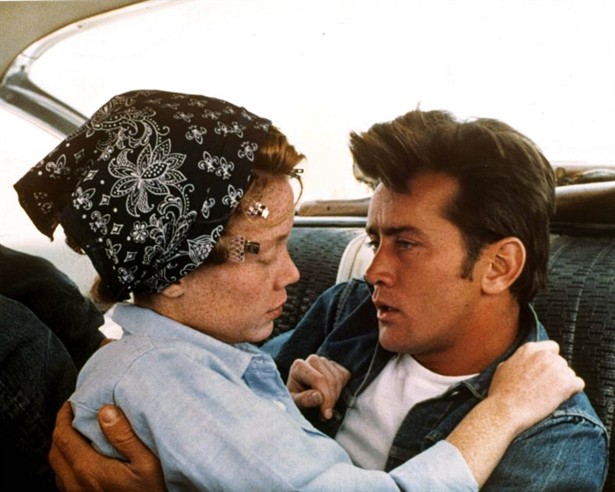
From beginning to end, Terrence Malick's "Badlands" (1973) kept me on the edge of my seat. I can't say that I really liked or disliked the movie. I would describe my attitude towards this film as fascinated, especially since the events are inspired by a true story. In my opinion, the strongest elements of this film are the cinematography and the creation of mood. From the moment that Kit (Martin Sheen) is introduced at the beginning of the movie, the viewer gets the overwhelming feeling of creepiness and danger, especially when he shows romantic interest in 14-year old Holly (Sissy Space).

As the events of the movie unfold the mood becomes even more frightening and bizarre after Kit unexpectedly kills Holly's father after he refused to let them be together. Subsequently, the couple hides out in a remote location in the woods and then goes on a road trip across the North Dakota Badlands. Throughout the movie, Kit kills individual after individual, never seeming to think before he pulls the trigger. In a weird manner, Holly seems to be almost desensitized to Kit's violent actions and the absurdity of the situation. Eventually, Holly wakes up and decides to abandon Kit and surrender to the authorities. In the end, Holly goes free and Kit is sentenced to death.

Connected back to the theme of criminality and celebrity, although lesser known than Bonnie and Clyde, the real life couple that inspired "Holly and Kit" are well known today as well. Bruce Springsteen's album "Nebraska" was inspired by the story of this couple. Like I said in a previous post before, the public has this extreme fascination with criminals and tends to glamorize their actions.

Bonnie and Clyde: Celebrated Criminal Duo


Bonnie and Clyde are arguably one of the most notorious couples in American history, particularly for their life of violence and crime. Before viewing this film, I only knew tidbits of information about this larger-than-life duo. After viewing this film, I had a better understanding of the story of Bonnie and Clyde, and how the time period factored into the lifestyle that they lived. As a history buff, it was pretty cool to see a depiction of 1930s Depression era Texas from the clothing to the cars to the style of the buildings. For a film of its time period (1967), the cinematography was pretty good.

In my opinion, the strongest aspect of this film was the character development and use of setting to tell a story. In the film, Clyde was an ex-convict and Bonnie was a bored waitress. The dismal atmosphere of the Depression and the lack of opportunities in their environment, especially for Bonnie,  were a major reason why Bonnie and Clyde started robbing banks. For example, the scene in which Clyde shot up the farm house that had been foreclosed on by the bank showcases the general feeling of rage that permeated throughout the Depression era.  For Bonnie and Clyde, robbing banks wasn't just for the money (in fact, they only robbed small banks), it was about feeling like they were "somebody."

This idea of feeling like "somebody" connects directly to the theme of criminality and celebrity we discussed in class. Through their criminal exploits, Bonnie and Clyde attained notoriety and became one of the most notorious couples in history. Although the idea of being a criminal is generally viewed as negative in society, it is hard to refute the fascination that the public has with criminals. Think of all the crime investigation shows and murder trials on television. They are shocking to watch, but you can't seem to turn away from the channel. As a whole, I really enjoyed this movie because it gave a strong backstory to Bonnie and Clyde, and showcased their human qualities, as opposed to the glamours of their criminal exploits.

Sunday, March 8, 2015

Chicago

I honestly love musicals,  I was even in a couple for my Drama Club at school, Chicago is one of my all time favorite musical. The reason why I love it so much is the music and the idea behind it. You see how, we have this woman who really wants to be famous and sings I feel like the movie is showing how sometimes people are willing to do anything, anything just to be famous. The movie goes on and shows the main character Roxie, and how she kills a man because he lied to her about making her famous.

As weird as this sounds I like how she would do anything to be famous and at least tried to find ways into becoming famous. This musical is something new. No matter how "old" it is. Musical would be how two people fall inlove but they can't because their families don't like that idea but Chiago is about how every women is for herself and at the end a strong friendship what was created.

Chicago, a 1975 musical, has a big twist and it has a lot of turns. Personally, being on stage and doing musical you like having good songs to show what does on in the play. Its a goo way to not get the crowd super bored.

The Viewer's Perception

In the previous class, we had finished watching When We Were Kings, a documentary about the acclaimed boxer, Muhammad Ali. One of the most striking aspects about this film is that its entire cast is composed of real characters. The real Don King. The real George Foreman. The real Muhammad Ali. There are no actors to be found, which cannot be said about all documentaries. However, to my surprise, it really did not help create a more realistic experience for the viewer compared to our last film, Malcolm X, which did not include any real characters. But I also did not know how the real Muhammad Ali looked, therefore, I could not tell if an actor was used in this documentary. If I had been familiar with him before, this would have altered my experience, and this same concept applies to Malcolm X, and all other films ever made. The viewer's perception of a movie greatly depends on their prior knowledge, whether it is about the characters, storyline, etc.

Often, books are made into films, such as the Hunger Games series. Let's say I watched the movie without reading the book first; this is commonly taboo for fans of any book series because of the significant discrepancies between the two. Movies tend to leave out crucial details, which disappoints avid readers, sometimes changing the entire point of the movie. But if I never read the book to begin with, I would've never known what was missing.

In the past five to ten years, Marvel has made a plethora of its age-old comics into modern-day movies. To many adults, who read these comics during their childhood, these movies are very appealing. Just think: they get a chance to see some, if not all of their favorite characters "come to life" in cinema. On the contrary, this experience can be less exciting for teenagers like me, since these comics came well before I was even born, many of which I have never even heard of. The few times I have gone to the theater with my dad to see these kind of films, I was left slightly, if not totally confused until he explained the plot. Sure the effects were cool, the cinematography was well-executed, but since the storyline wasn't clear to me, all of the pizazz didn't matter. Ancient films like Psycho, The Birds, and even Alien may be considered antiquated to some people, but their "bare bones" style definitely appeals to me since I understand the majority of the scenes.

There aren't many movies in which the viewer can fully grasp every single concept displayed, and this certainly isn't done by accident. As a ThunderClap filmmaker myself, I know firsthand how important it is to keep the viewer guessing, to a certain extent at least. You don't want to tell them all of the details, but you don't want to leave them confused either. In the end, it's all about striking a balance.